I still remember the first time I dropped into Pandora. It was 2026, years after Avatar: Frontiers of Pandora first launched, and I finally decided to see whether it was just another Ubisoft open-world game or something more. I had heard the criticisms. I had played Far Cry 3, Ghost Recon, and Assassin's Creed. I knew the formula: clear camps, hunt resources, craft gear, chase waypoints. So I expected to be bored. Instead, I found myself leaping through alien vines and actually reading the landscape. That surprised me.
The Ubisoft Formula I Know Too Well
Open-world games have been around since the 1980s, but the modern Ubisoft formula really crystallized with Far Cry 3 in 2012. That game asked me to gradually clear enemy camps, hunt for resources, craft better gear and weapons, and take on a range of side quests. At the time, it felt fresh and exciting. Over the years, though, Ubisoft kept returning to the same well. Far Cry, Ghost Recon, Assassin's Creed — the loop was everywhere. Long-time fans like me started to feel tired of it. So when Avatar: Frontiers of Pandora was first revealed and looked very similar to a Far Cry game, I felt a little disappointed. I thought I already knew exactly what I was going to get.
But that first impression was not the whole story. Avatar: Frontiers of Pandora is still a Ubisoft open-world game, yes, but its developers managed to put a few unique spins on the same old formula. And those spins made a bigger difference than I expected.
Spin One: Parkour That Feels Na'vi
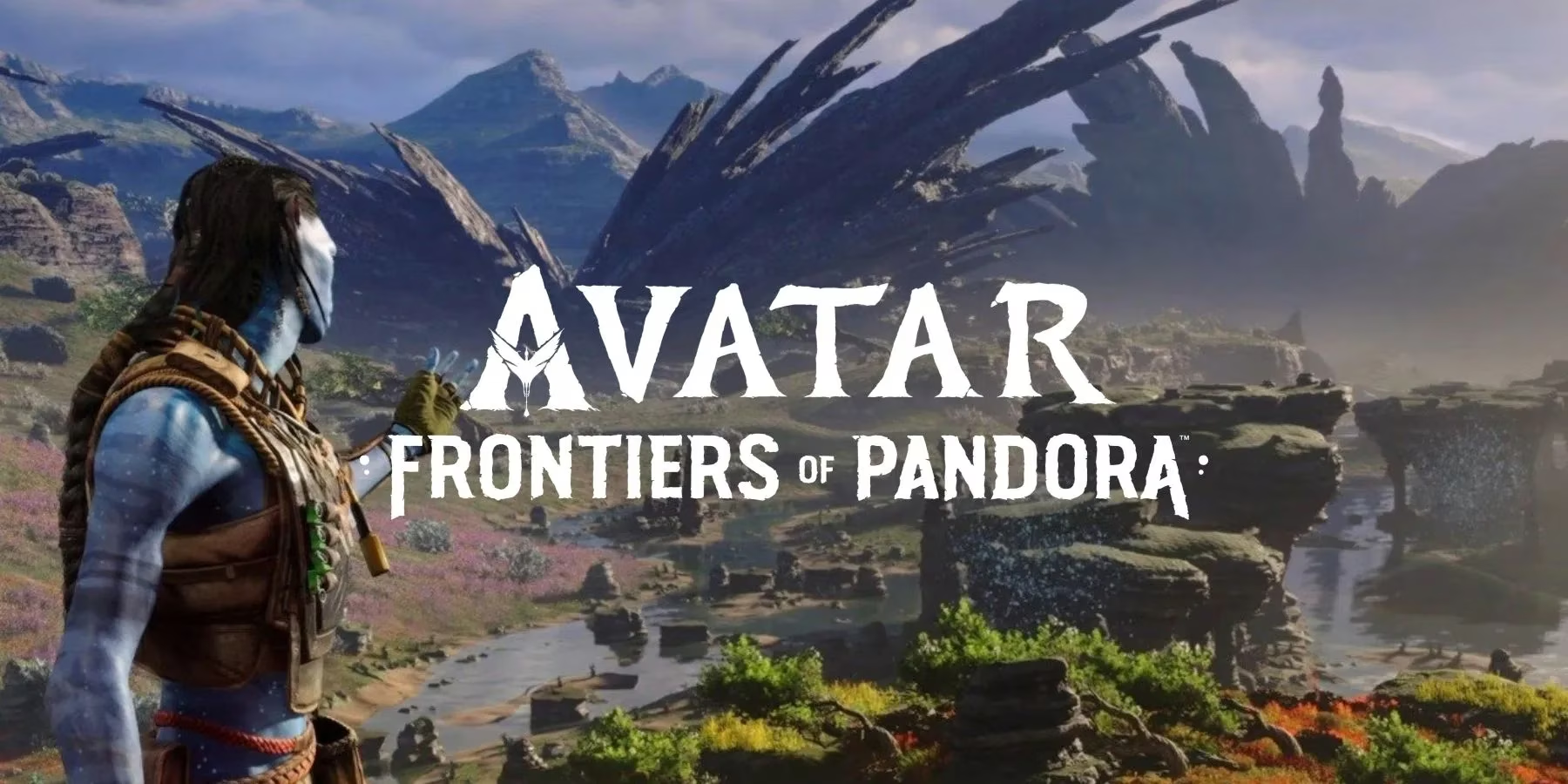
One of the biggest and best twists is the emphasis on parkour. In an attempt to capture the athleticism of the Na'vi from James Cameron's movies, Ubisoft implemented a simple but effective parkour system. I got a supercharged jump almost immediately. I could scale vines, trees, and most other parts of Pandora's lush environment. When I unlocked further parkour skills, I could build real momentum. That flow is not something I often find in a Ubisoft open-world game. It made traversal feel like play, not just travel.
Spin Two: Player-Led Exploration
Another unique spin is the heavy emphasis on player-led exploration. Most Ubisoft open-world games are criticized for their overreliance on constant waypoints and objective markers. Avatar: Frontiers of Pandora still has markers, but they tend to give me only a general area to search. I had to pay attention to the environment itself and use the compass directions to find my target. I remember one side mission where the marker was just a glowing circle. I had to listen to the wind, watch the colors of the plants, and use my senses. It felt more like real exploration and less like following a GPS.
Here is how I would compare the classic formula to what Avatar does:
| Classic Ubisoft Open-World Loop | Avatar: Frontiers of Pandora Twist |
|---|---|
| Clear enemy camps one by one | Still present, but parkour and verticality change the rhythm |
| Constant waypoints | General search areas, compass, and environmental clues |
| Ground-based movement | Supercharged jump, vines, trees, and momentum |
| Crafting and loot | Still there, but tied to Na'vi survival and the world |
| Map-clearing checklist | More player-led discovery, though not entirely free of icons |
I will not pretend the game is perfect. The enemy camps can feel repetitive. The loot system can feel familiar. Some quests still boil down to clearing an outpost. But the parkour and the softer approach to waypoints gave me enough ownership over my journey. I often turned off the compass and just wandered. That is when Pandora felt most alive.
What I Took Away in 2026
By 2026, Avatar: Frontiers of Pandora has had time to settle. Its post-launch expansions, including The Sky Breaker and Secrets of the Spires, added new regions and challenges, but the core identity stayed the same. It is a beautiful, comfortable, and occasionally surprising open-world game. It did not reinvent the wheel. If you hate the Ubisoft formula, this game probably will not convert you. But if you want to feel like a Na'vi, to leap through alien forests and actually look at the world instead of staring at a mini-map, it works.
I went in expecting another Far Cry clone. I came out with a new favorite way to explore Pandora. That is not nothing. In a year full of massive open worlds, Avatar: Frontiers of Pandora still gives me a reason to climb one more tree and see what is beyond the next ridge.
Recent analysis comes from Digital Foundry, whose technical reporting helps explain why Avatar: Frontiers of Pandora can feel more immersive than a standard checklist-driven open world, especially when dense foliage, long sightlines, and fluid traversal combine to make movement through Pandora itself part of the experience rather than just the route between objectives.