When Avatar: Frontiers of Pandora arrived, fans of James Cameron's universe expected a faithful recreation of the lush jungles seen in the 2009 film. Massive Entertainment delivered exactly that in the Kinglor Forest, where every chirp, glowing plant, and familiar creature makes players feel as though they have stepped directly into Omaticaya territory. But the most surprising and impressive part may not be the movie-accurate biomes at all. It is the Upper Plains, an original region built from scratch, that has become a masterclass in environmental storytelling.
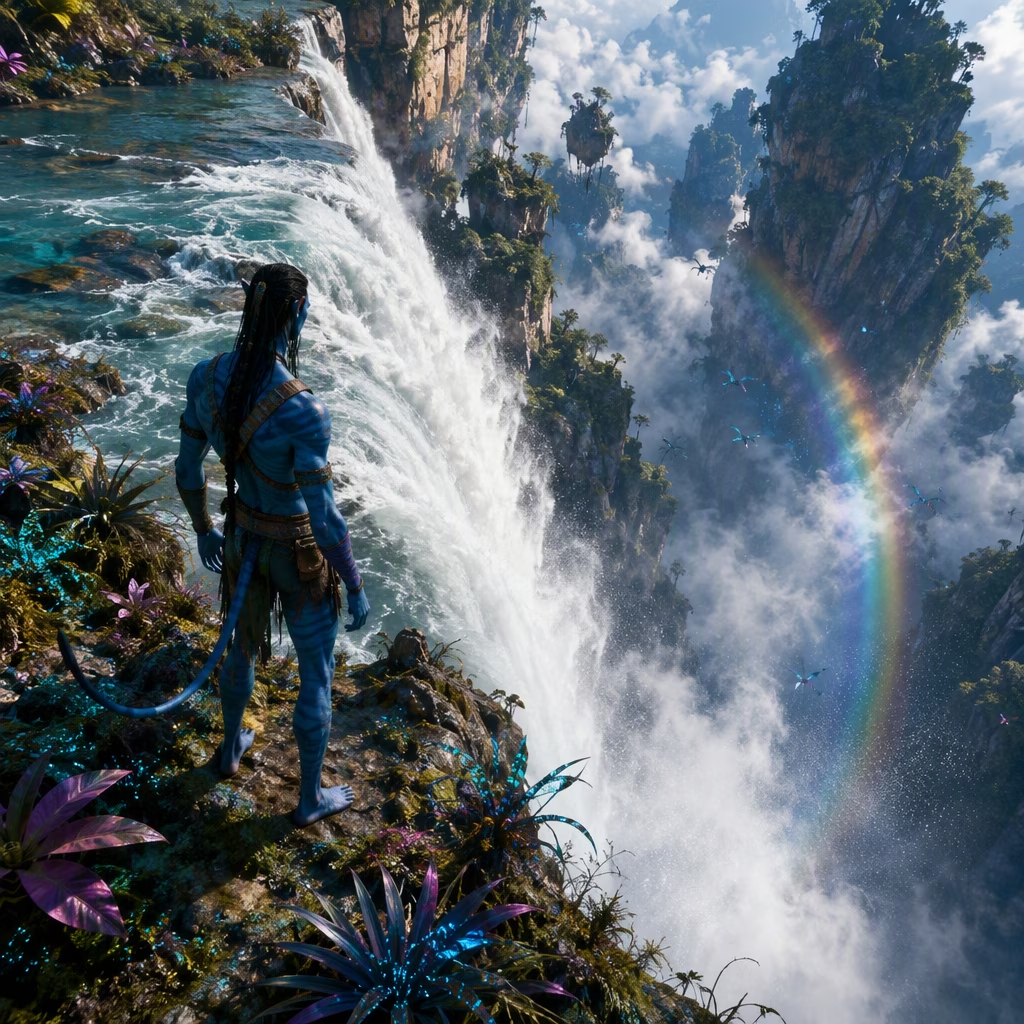
For players who think they have seen everything Pandora has to offer after the forest, the journey into the Upper Plains is genuinely startling. The game opens up its second act with a passage through a cave, and on the other side lies a landscape that feels like a different planet altogether. Rolling, multicolored hills stretch toward the horizon, shaped by winds powerful enough to bend entire ecosystems to their will. It is not just a new map; it is a new way of life.
A Region Built Around the Wind
What makes the Upper Plains so convincing is that every detail flows from a single ecological foundation: the wind. Other open-world games often treat weather as a cosmetic effect. Here, the wind is the region's central character. Trees do not grow straight up; they lean sideways. Large, thistly bushes anchor themselves with deep roots because anything without a firm grip would simply be torn away.
The animals follow the same logic. The Kinglor Forest is home to fast, nimble predators that weave through dense vegetation. The Upper Plains, by contrast, are populated by large grazing herbivores. Their sheer size helps them withstand the constant gusts. Smaller, quicker creatures would struggle in such an exposed environment, so the food chain evolved differently.
Some of the smaller details are especially memorable. Native plants launch their spores high into the sky like tiny missiles so the wind can carry them across the open plains. Canyon walls channel the wind into invisible barriers that keep flying predators out. In those sheltered pockets, life has evolved along its own path. These touches are not just decorative; they explain why the world looks and behaves the way it does.
The Zeswa Clan and the Zakru
The human element of the Upper Plains is just as thoughtful. While the forest-dwelling Aranahe live above the treeline on the backs of ikran, the Zeswa ride direhorses across open ground. They do not have a Home Tree or a fixed settlement. Instead, the Zeswa are nomadic, roaming the plainlands and making camp wherever their journey takes them.
Their culture revolves around the Zakru, enormous elephant-sized creatures that travel with the clan. The Zakru are not simply mounts or background decoration. Their massive bodies block the wind, making life possible in the most exposed areas. The Zeswa build their base camps next to them, drink their milk, and organize much of their culture around protecting these animals. When the Zakru migrate, something that happens only once a generation, the entire clan moves with them.
One might wonder: how often do movie tie-ins expand the lore of their source material so naturally? The Upper Plains does not contradict the Avatar films. It extends them. It suggests that Pandora is vast enough to contain many different evolutionary answers, and that the Na'vi are as varied as the environments they call home.
How the Details Build a Believable World
Massive's approach works because it is holistic. Plants, animals, weather, and culture all influence one another. The Zeswa use kites as landmarks because the open sky and strong winds make kites practical and visible across long distances. They carve wind flutes that turn the constant airflow into music that can be heard far across the region. Even the placement of camps makes sense: they shelter inside giant bushes, not in exposed clearings.
The table below shows just how thoroughly the Upper Plains separates itself from the Kinglor Forest.
| Aspect | Kinglor Forest | Upper Plains |
|---|---|---|
| 🌿 Terrain | Dense jungle, vertical canopy | Rolling hills, open valleys |
| 🦅 Travel | Ikran above the trees | Direhorses across the plains |
| 🏠 Settlements | Home Tree, fixed camps | Nomadic camps near Zakru |
| 🌬️ Main pressure | Jungle predators, verticality | Constant high winds, migration |
| 🎵 Landmarks | Bioluminescent flora, forest sounds | Wind flutes, kites, open sky |
Could any other open-world title make wind feel like a genuine design pillar? Many have tried, but few succeed this well. The Upper Plains does not shout its cleverness. It simply places players inside a working system and lets them feel the logic of the place through movement, sound, and survival.
A New High Bar for Virtual Worlds
Each of Frontiers of Pandora's three regions has a strong identity. The Clouded Forest is particularly inviting for anyone who loves misty, temperate woodlands. But the Upper Plains stands on its own as one of the most impressive open-world locations ever created. As of 2026, it remains a benchmark for environmental storytelling and for iterating on an already-established universe.
Massive Entertainment has done plenty of great work over the years, but this region should be the studio's calling card. It proves that a movie tie-in can contribute something meaningful to the world it adapts. The Upper Plains is not just a beautiful backdrop. It is a living, breathing place with its own rules, its own culture, and its own unforgettable relationship with the wind.