By 2026, Avatar: Frontiers of Pandora remains one of Ubisoft's more curious open-world experiments. It is an action-adventure in every sense of the phrase, sending players into the gorgeous world of Pandora to complete a familiar Ubisoft open-world loop: taking down RDA facilities, hunting wildlife, gathering ingredients, crafting upgraded weapons and gear, and learning more about the rich history of James Cameron's Avatar universe. Yet the game is no slouch at throwing a few surprises into the mix, and its parkour system is arguably the biggest and best of them.
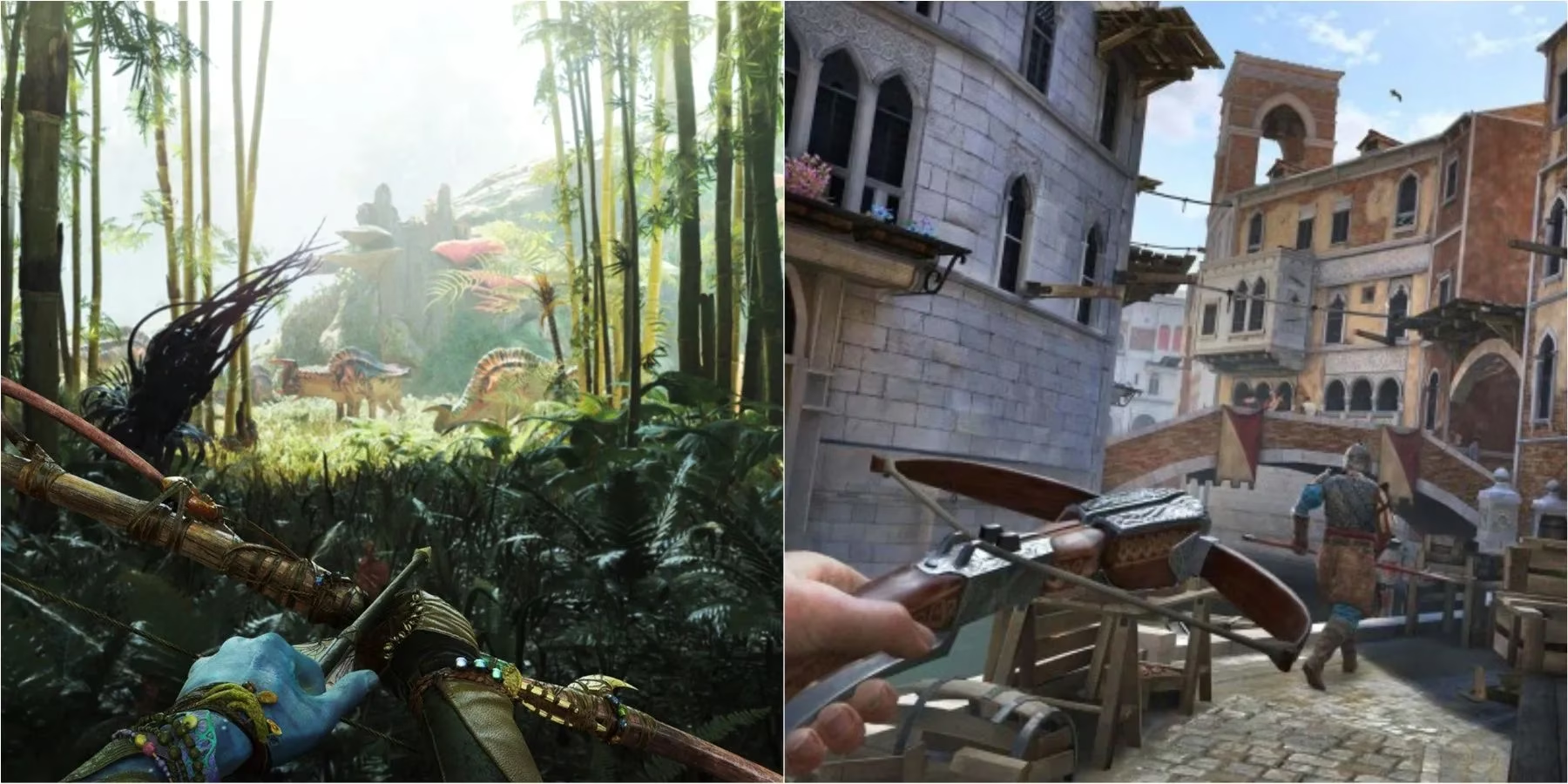
From the get-go, Avatar puts parkour front and center. While breaking out of the RDA facility at the start of the story, players are given immediate access to a slide and a charged jump, the latter of which can reach pretty tall heights. When approaching a ledge or a low-to-the-ground obstacle, the player-character automatically mounts and climbs it, paving the way for fast-paced movement. It is a simple touch, but it goes a long way toward making players feel like a nimble, athletic alien species rather than a clumsy tourist with a gun.
As players progress, they unlock a slew of new abilities, many of which revolve around parkour. They can dash through the air to gain extra momentum, roll upon hitting the ground from great heights to avoid fall damage, and pick up a plethora of other genuinely helpful skills. The system is not the most complex in the medium, but it is a big highlight of Avatar: Frontiers of Pandora. It captures the feeling of being this athletic alien species and, in turn, makes the game feel authentically part of the Avatar universe.
Naturally, it is hard not to think of another Ubisoft franchise that revolves around fast movement and parkour. Avatar's mechanics make a strong case for a first-person Assassin's Creed game. Some of Avatar's more fantastical parkour abilities probably would not work in the more grounded Assassin's Creed series, but the basic gameplay mechanics could form a nice blueprint for a new type of Assassin's Creed title, informing its controls and the general speed and flow of momentum.
A first-person Assassin's Creed would need to build on Avatar's groundwork in some major ways. The ability to scale walls would need to be implemented, along with the ability to use additional gadgets like a hookblade or grappling hook. For this, Ubisoft may want to take inspiration from Mirror's Edge Catalyst, which has similar parkour abilities and gadgets in a first-person setting. The result could be a breath of fresh air for a series that has spent recent years balancing old-school stealth with RPG-scale worlds.
Here is how Avatar's movement toolkit could translate to a first-person Assassin's Creed project:
| Avatar: Frontiers of Pandora element | Why it matters | First-person Assassin's Creed potential |
|---|---|---|
| 🧗 Charged jump | Reaches tall heights and clears gaps | Gives vertical traversal a punchy rhythm |
| 🏃 Slide | Provides quick, low-profile movement | Useful for chases, escapes, and tight spaces |
| 🧗 Auto-mount and climb | Keeps momentum when approaching ledges | Smooths rooftop and wall transitions |
| 💨 Air dash | Adds extra momentum in mid-air | Supports bold leaps between buildings |
| 🤸 Landing roll | Avoids fall damage from great heights | Rewards daring descents |
| 🌿 Plant speed boost | Delivers an environmental burst of speed | Could become a gadget-based sprint boost |
The table makes the appeal clear. Avatar's parkour is not just a way to get from point A to point B; it is a way to make the world feel traversable, expressive, and a little bit reckless. A first-person Assassin's Creed could kick things up a notch by turning that momentum into stealth, chases, and quick getaways. Players could vault across rooftops, slide under obstacles, grapple onto ledges, and roll into a hidden alley before a guard even knows what hit them.
Still, the idea would raise a few eyebrows. First-person parkour is tricky to tune, and motion sickness, field of view, and spatial awareness are no joke. Combat and stealth would also need careful handling. A first-person Assassin's Creed could not simply copy Avatar's alien athleticism and call it a day; it would need to ground the movement in the series' fantasy of precise, deliberate assassination. Ubisoft would have its work cut out for it, but the publisher already has the tools and the open-world know-how.
By 2026, the conversation around first-person parkour has only grown more interesting. Avatar: Frontiers of Pandora proved that Ubisoft can make fluid, first-person movement feel good in a big open world. It is not a full Assassin's Creed game in disguise, and it does not need to be. But its parkour system is a strong proof of concept. If Ubisoft ever wants to take the leap, Avatar has already shown that the first-person view can handle the whole nine yards: climbing, sliding, dashing, and landing with style. The only question is whether the publisher is willing to take the hint.
Insights have been gathered from Digital Foundry, whose performance-focused reporting helps frame why Avatar: Frontiers of Pandora's first-person parkour feels so striking in practice: fluid traversal systems rely not just on animation design, but on stable presentation, readable environmental detail, and responsive movement feedback, all of which would be essential if Ubisoft ever adapted similar momentum-heavy ideas into a first-person Assassin's Creed.